Job and Faith After Losing Everything
Job and faith collide in seasons of loss and silence. Find hope when disappointment with God leaves you hurting and asking hard questions.

Job and Faith After Losing Everything
What happens to faith when the diagnosis is final, the job is gone, the relationship cannot be repaired, and prayer seems to meet only silence? Job’s story does not ask us to minimize that kind of pain. It gives us language for staying before God when suffering feels unfair and nothing makes sense.
How Do You Hold Onto Faith When God Seems Silent?
Holding onto faith does not mean denying grief or forcing yourself to feel hopeful. It means continuing to bring your anger, questions, and sorrow to God, even when no answer comes. Job shows that honest lament can be an act of faith: you are still speaking to God because some part of you believes he is listening.
Why Can Suffering Feel So Unfair?
Some losses follow clear causes. A reckless decision produces consequences. A neglected relationship breaks down. But much suffering does not fit that pattern. A careful driver is struck by someone who runs a red light. A devoted parent loses a child. A faithful employee is included in a round of layoffs. A person who prayed for years receives the medical news they feared most.
Job’s suffering was not presented as punishment for secret wrongdoing. At the beginning of the book, he is described as “blameless and upright” (Job 1:1). Then, in a devastating sequence, he loses his livestock, servants, financial security, and children. Later, his body is covered with painful sores. His life is dismantled in public, while the reasons remain hidden from him.
That detail matters because people in grief often assume they must have failed God. Others may reinforce the suspicion. Job’s friends initially do something compassionate: they sit with him in silence for seven days. Then they begin explaining. Their explanations become accusations. They insist that suffering must be evidence of sin, because their view of God has no room for undeserved pain.
Job refuses their neat system. He examines his life and will not confess to crimes he did not commit merely to make his story easier to understand. His honesty can sound unsettling. “I cry out to you, God, but you do not answer,” he says in Job 30:20. That is not polished religious speech. It is the voice of a wounded man who expected God to respond and cannot understand the silence.
Suffering feels unfair because sometimes it is unfair. Scripture does not require us to rename injustice as blessing or call devastation a hidden gift. Grief is not ingratitude. Confusion is not rebellion. There are moments when the most truthful prayer is simply, “God, I do not understand why you allowed this.”
What Does Job’s Story Teach Us About God and Loss?
The book of Job does not give a simple answer to the question of why good people suffer. Readers are shown a heavenly conversation that Job never hears, but even that scene does not explain every form of suffering. The book is less interested in giving us a formula than in exposing the limits of our formulas.
Job believed that faithful living should lead to a stable life. His friends believed the same thing. Their disagreement was over whether Job had secretly violated the arrangement. Yet the story challenges the arrangement itself. Faith is not a contract in which obedience guarantees health, financial security, a lasting marriage, successful children, or protection from tragedy.
This is difficult because many of us carry unmet expectations we have rarely spoken aloud. We expected prayer to change the test result. We expected years of service to protect a ministry from collapse. We expected God to restore a relationship because reconciliation seemed like the most faithful outcome. When that expectation dies, we grieve both the loss itself and the version of God we thought we understood.
Other biblical figures knew this tension. Hannah endured years of infertility and the cruelty of a rival before Samuel was born. Sarah waited so long for the promised child that hope sounded absurd. David, though anointed as king, spent years hiding from Saul and asking how long God would forget him. Psalm 13:1 records his blunt question: “How long, Lord? Will you forget me forever?”
These stories do not promise that every Hannah will have a child, every Sarah will see the outcome she hoped for, or every person running from danger will eventually sit on a throne. They show something more careful: disappointment and faith can occupy the same heart. God’s people have often trusted him without understanding his timing or receiving the ending they wanted.
When God finally speaks to Job from the whirlwind, he does not explain the chain of events. Instead, he reveals the vastness and complexity of creation. That response can feel frustrating, especially when we want reasons. Yet God is not mocking Job’s pain. He is showing Job that the world is larger than the moral arithmetic offered by his friends, and that divine silence is not the same as divine absence.
The restoration at the end of Job should also be handled gently. New possessions and more children do not erase the children who died. Restoration is not reimbursement. Job carries a history that cannot be undone. The ending offers evidence that suffering does not have the final word, but it does not ask us to pretend that what was lost did not matter.
How Can You Move Through Grief When Answers Do Not Come?
Begin by telling the truth about what happened. Name the loss without softening it. “My marriage ended.” “My child died.” “I cannot pay the bills.” “My body is no longer reliable.” “The prayer I prayed was not answered as I hoped.” Specific grief can be brought to God; vague religious language often keeps pain at a distance.
Then allow lament to become part of your prayer life. Lament is not complaining about God from a safe distance. It is bringing your complaint directly to him. Job argues, protests, remembers better days, and asks to be heard. David does the same in the Psalms. Their prayers teach us that faith can speak in a cracked voice.
If words are difficult, borrow theirs. Read Job 30, Psalm 13, Psalm 22, or Psalm 88 slowly. You do not need to finish with a cheerful sentence. Psalm 88 ends in darkness, and Scripture leaves it there. The Bible makes room for prayers that have not yet reached relief.
It also helps to separate God from the people who speak carelessly on his behalf. A friend may say, “Everything happens for a reason,” when what they really mean is, “I do not know how to sit beside this.” Another may suggest that stronger faith would have produced a different outcome. Job’s friends remind us that religious confidence can wound people when it outruns compassion.
Look instead for someone willing to stay without solving you: a pastor, counselor, trusted friend, support group, or family member who can hear the same story more than once. Professional care is not a failure of faith. Grief affects sleep, memory, appetite, concentration, and the nervous system. Sometimes holding onto life requires prayer and therapy, Scripture and medication, solitude and practical help.
Keep your next act of faith small. You may not be able to imagine trusting God for the next year. Can you ask for enough strength to get through this morning? Can you drink water, answer one message, sit outside for ten minutes, or let someone bring dinner? After profound loss, ordinary care can be a form of courage.
For further reflection on prayer during bereavement, read When God Feels Silent in Your Grief. Silence can feel personal, but you do not have to interpret it alone.
How Do You Keep Faith Without Pretending It Does Not Hurt?
Faith after loss may look different from faith before loss. Before, it may have felt confident and energetic. Afterward, it may be quieter: returning to prayer without feeling comfort, sitting in church while unable to sing, or letting someone else believe on your behalf for a while. Fragile faith is still faith.
Job remains in relationship with God by refusing to fake the relationship. He does not praise on command or accept explanations he knows are false. He keeps addressing God. Even his anger reveals an expectation that God is just and should hear him. Job’s questions are not the opposite of faith; they are faith struggling to breathe.
There may also be days when you feel nothing toward God. Do not panic. Emotional numbness is a common response to overwhelming loss. Your relationship with God does not depend on maintaining a certain spiritual mood. You can rest, receive care, and let familiar prayers carry you when your own words are unavailable.
Hope, in this setting, is not certainty that circumstances will improve quickly. It is not insisting that every loss will be replaced in the form we desire. Christian hope rests in the character of the God revealed in Jesus: a God who enters suffering, weeps at a grave, bears wounds, and rises without denying that the crucifixion happened.
The wounds of the risen Christ were still visible. That is a useful picture for faith after losing everything. Healing does not always mean becoming untouched. Sometimes it means discovering that pain can remain part of your story without remaining the sole author of it.
You may never receive a satisfying explanation for what happened. Job did not. But unanswered questions do not prevent an honest life with God. You can grieve what was taken, reject shallow answers, accept help, and continue turning toward him—even if, for now, that turning is barely more than a whisper.
Can Hope Survive When Life Is Not Restored?
Some stories do not resolve as we hoped. The relationship remains broken. The empty chair stays empty. The body continues to hurt. The opportunity does not return. Biblical hope must be strong enough for those realities, or it is not much use to suffering people.
Job’s story says that loss is not proof that God has abandoned you. It also says you do not need to defend God by denying your own wounds. The Lord rebukes Job’s friends for failing to speak rightly about him, while Job—the one who protested and lamented—is received.
That should make us slower to offer explanations and quicker to offer presence. It should also free those who suffer to come before God without editing every sentence. “I am still here, but I am hurt” is a faithful prayer. So is, “I want to trust you, but today I do not know how.”
Hope may not arrive as an answer. It may begin as the courage to tell God the truth and return tomorrow. The pain is real, the silence may continue, and the story is not finished—even if, today, you cannot see beyond the loss.
Keep Reading
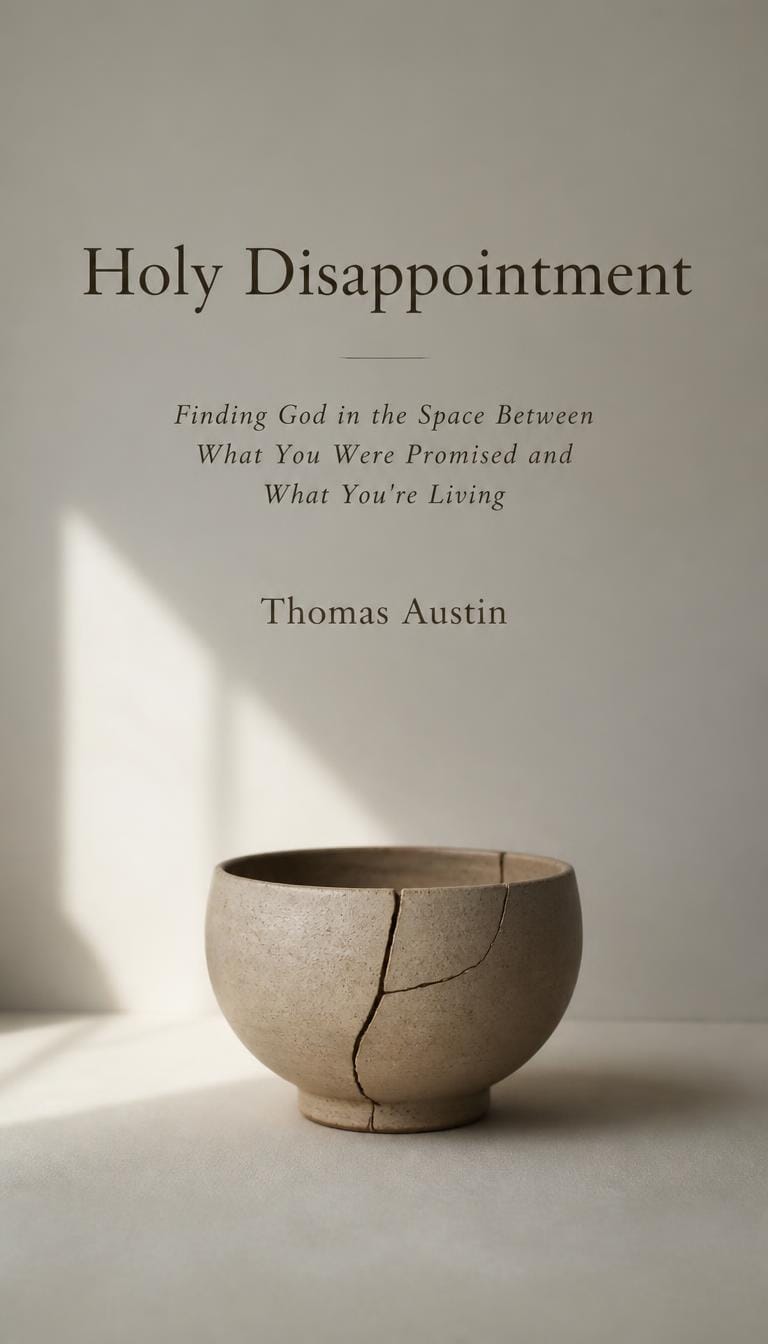
If this resonated, my book Holy Disappointment goes further into finding god in the space between what you were promised and what you're living. A companion for anyone whose faith didn't turn out the way they expected. Holy Disappointment walks through twenty chapters of honest reflection on unmet expectations, unanswered prayers, and finding God in the gap between what you were promised and what you're living. Get Holy Disappointment on Amazon.


Comments ()